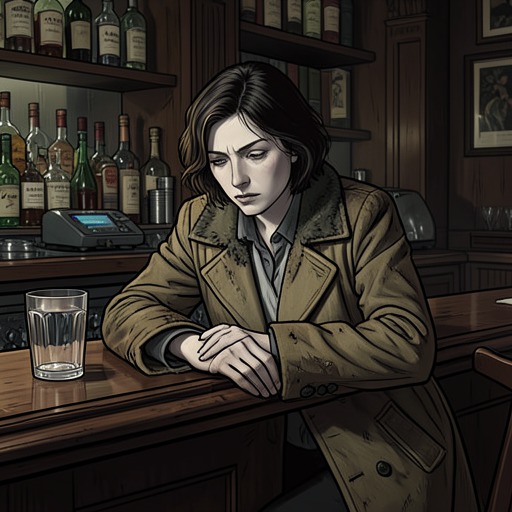
Scott imprisons and assaults Rachel
The Girl on the TrainScott’s assault and imprisonment of Rachel mark the collapse of her invented closeness to Megan and the moment her investigation places her in immediate danger. A visit to the Hipwell home becomes a confrontation over Megan’s other relationships, Rachel’s false claims, and information she has given to the police; afterward, Rachel reports what happened but is told to keep away from Scott.
The DNA result and the confrontation
Rachel visits Scott while preparing for a job interview the following day and tells him she cannot stay long. He insists that she sit and pushes a beer toward her. Then he tells her that DNA results have established that he was not the father of Megan’s baby. Kamal was not the father either. Scott treats the result as evidence that Megan had another lover and presses Rachel to say whether she knew about him.
The discovery changes the balance of the conversation. Rachel is frightened of answering incorrectly, and when she tries to leave, Scott grips her arms and pushes her back into the chair. He takes her handbag and accuses her of having known about Megan’s lovers. His questioning exposes the basic deception in Rachel’s approach: she and Megan were not friends, and Rachel had never met her. Scott understands that the account Rachel gave him was a lie.
Confinement and release
Scott later confronts Rachel again, demanding to know what she has been doing and what she has been saying. He believes she has been working against him and giving information about him and Megan to another person. Rachel says she had been trying to help. He takes hold of her and drags her upstairs, then locks her in the spare room. The confinement is a sharp reversal: Rachel entered the Hipwell home to pursue her own questions, but Scott now controls whether she can leave.
The room contains papers and files, a fold-up treadmill, an old Apple Mac, and boxes of papers and blank postcards. As she searches through the cards, Rachel finds a broken picture frame and takes a shard of glass, keeping it in her pocket. When Scott comes back, he has her handbag and the scrap of paper on which she has written her theory about Megan’s disappearance. He mocks the theory and Rachel’s supposed friendship with Megan, then tells her to leave.
Scott briefly steps into her path as she reaches the door, but does not stop her. Rachel leaves the house. His release of her ends the immediate confinement, not the danger: she is still afraid of what he may do, and the confrontation has confirmed that he knows she misrepresented her connection to Megan.
Reporting the incident
After leaving Scott’s, Rachel goes to 23 Blenheim Road and tries to reach Tom Watson. No one answers, so she pushes a note through the letterbox. She keeps it vague and does not name Scott, because she does not want Tom to go to the Hipwell home and confront him. The choice shows that Rachel’s fear extends beyond what has just happened to the possibility of another confrontation.
Rachel then calls the police and speaks to Detective Sergeant Riley rather than Detective Inspector Gaskill, whom she had hoped to reach. She reports that Scott imprisoned and threatened her. Riley asks how long she was held; Rachel estimates about half an hour. The police have searched the house and seen the photograph, but Riley tells her that this is not enough evidence of murder. Scott is not arrested. Instead, Riley asks Rachel to come to the station the next day to make a statement and warns her to stay away from him.
Consequences and narrative significance
The incident links Rachel’s unstable position as an investigator to the risk created by her unreliable account of how she knew Megan. Scott’s questions move from the DNA result to Rachel’s invented friendship, and then to his suspicion that she has been helping someone else. The encounter therefore does more than threaten Rachel: it exposes the false premise on which she approached Scott and makes her involvement visible to him.
The aftermath offers no immediate protection or resolution. Rachel has escaped the house, but the police response leaves her responsible for returning to give a statement while explicitly advising her to avoid Scott. Her attempt to help and investigate has become a confrontation, and the official response does not remove the uncertainty or danger that follows it.